
Short answer
A sales playbook template is a fill-in outline for writing down how your team sells: who you target, how you research and reach them, what you say, how you qualify and how you handle objections. A useful team playbook fits on about six pages, links out to scripts and battlecards, and has one owner who reviews it every quarter. For important deals, add a one-page account playbook that applies it to a single company.
- Write two documents: a team playbook for the segment and a one-page playbook for each important account.
- Build it from your last 20 won and 10 lost deals, not from a brainstorm.
- Give each module one job: research, messaging, qualification or objections.
- Put a source next to every claim in the proof library.
- One owner, a quarterly review and call coaching against the playbook keep it alive.
On this page
- Team playbook or account playbook
- The team playbook outline
- How to build it in two weeks
- The four modules reps use every day
- Completed example: an outbound playbook for payroll software
- From team playbook to account playbook
- Rules your playbook should state
- Maintenance and coaching checklist
- Common mistakes
- Sources
- Questions people ask
This template is for sales leaders, enablement managers and founders writing down how their team sells, and for reps who want a consistent way to prepare important accounts. It assumes you have some wins to learn from. If you're still deciding who to sell to, start with the ideal customer profile template and come back. Expect the first version to take two or three days of work spread over two weeks, most of it reading old deals and listening to calls.
Team playbook or account playbook
"Sales playbook" covers two different documents. Most teams need both.
| Team playbook | Account playbook | |
|---|---|---|
| Answers | How we sell to this segment | How we win this one company |
| Written by | Sales leader or enablement, with top reps | The rep who owns the account |
| Length | About six pages, plus linked templates | One page |
| Changes | Quarterly, or when what wins changes | Whenever something changes at the account |
| Contents | ICP, buyers, triggers, modules, deal stages, competition | Named people, the trigger and its source, the angle, likely objections, next steps |
| Open it when | Onboarding, coaching, planning a quarter | Before every call or email to that account |
The team playbook is the rulebook. The account playbook is the plan for one match. A rep with only the team playbook knows the approach but not why this company should care now. A rep with only account notes reinvents the approach every time.
Write an account playbook when any of these is true: the deal would be in your top fifth by value, three or more people will have a say, or losing it would cost you a reference you want. For smaller accounts, the research card from the team playbook is enough.
The team playbook outline
Ten sections. The length column is a ceiling, not a target.
| Section | What it answers | Length | Build it from |
|---|---|---|---|
| 1. Who we sell to | Which companies, and which we don't | Half a page | ICP, closed-won list |
| 2. Who we talk to | Roles and what each cares about | Half a page | Contacts on won deals |
| 3. Why they buy | Problems, triggers, proof | One page | Win interviews, call recordings |
| 4. Research module | What to check before first contact | Half a page | Top reps' habits |
| 5. Messaging module | Openers by trigger and role | One page | Emails and calls that got replies |
| 6. Qualification module | Must-know answers, walk-away rules | Half a page | Lost and stalled deals |
| 7. Objections module | Top objections and responses | One page | Call recordings |
| 8. Deal process | Stages, exit criteria, who to involve | Half a page | CRM stage history |
| 9. Competition | Who you meet, where you win and lose | Half a page, plus battlecards | Win/loss notes |
| 10. Rules and upkeep | Compliance basics, owner, review date | A few lines | Counsel, enablement |
TEAM SALES PLAYBOOK: [segment]
Owner: [name]   Version: [1.0]   Last reviewed: [date]   Next review: [date]

1. WHO WE SELL TO
Ideal customer in one sentence:
Must-haves (size, location, industry, situation):
Disqualifiers (be specific, with numbers):

2. WHO WE TALK TO
Role | What they care about | Part in the deal (starts, tests, signs, can block)

3. WHY THEY BUY
Problems, in customers' own words (quote them):
Triggers that start a buying process:
Proof we may use (customer, result, source, permission):

4. RESEARCH MODULE  (see module card)
5. MESSAGING MODULE  (see module card)
6. QUALIFICATION MODULE  (see module card)
7. OBJECTIONS MODULE  (see module card)

8. DEAL PROCESS
Stage | Exit criterion (what the buyer has done) | Who we involve

9. COMPETITION
Who we meet most | Where we win | Where we lose | Battlecard link

10. RULES AND UPKEEP
Email, calling and claims rules we follow:
How reps suggest changes:
Change log:
How to build it in two weeks
- Pull the evidence. Export your last 20 closed-won and 10 closed-lost deals. For each, note the segment, the trigger, the first contact channel, who was involved, the objections raised and the real reason it was won or lost.
- Interview three reps, including your best and your newest. Ask what they check before first contact, what they say first, and when they walk away.
- Listen to ten recorded calls, five won and five lost. Write down the prospect's exact words for problems and objections. Those words go into the playbook as quotes.
- Draft sections 1 to 3 first. If you can't fill "why they buy" with customer words, stop and do more interviews before writing anything else.
- Draft the four modules, linking to full scripts, templates and battlecards instead of pasting them in.
- Test it on a new rep. Ask them to prepare one real account using only the playbook, and write down every question they had to ask someone. Each question is a gap.
- Publish it with an owner, a version number and a review date, somewhere reps already work.
The four modules reps use every day
Sections 4 to 7 are where reps spend their time. Give each module one job and link it to the deeper resource.
Research module
BEFORE FIRST CONTACT, FIND:
1. Fit: [the must-haves from section 1]
2. One trigger from the last six months: [your trigger list]
3. The person: [role], and how long they've been in it
4. What they use today: [current tool or process, if public]
5. Why it matters now: [what the trigger usually causes]

WHERE TO LOOK, IN ORDER:
Company news page, careers page, leadership page,
local business news, public filings, leaders' public posts

CHECK BEFORE USING ANY FACT:
Is this the right company (not a namesake or a subsidiary)?
Does the fact have a source and a date?
Is it still true?

TIME LIMIT: [15] minutes. No trigger found: park the account for [90] days.
The checks at the bottom matter more than they look. When Blackpearl Group (Bebop's parent company) built GTM-Bench, a 2026 benchmark of AI prospecting agents, the authors found that failures came from identity errors (the wrong company or person), unsupported claims and poor decisions about when to stop. Human research fails the same three ways. A module that says "confirm the entity, source every claim, stop at good enough" prevents most of it. The account research guide covers the method in full.
Messaging module
FOR EACH TRIGGER x ROLE:
Trigger: [e.g. expanded into a new state]
Role: [e.g. payroll manager]
What it usually causes, in their words: [quote]
Opening line: [one sentence that names the trigger]
Proof: [similar customer, result, source]
Small ask: [15 minutes, day, time, purpose]

PHRASES WE DON'T USE:
[e.g. "industry-leading", "quick chat", "just checking in"]

FULL TEMPLATES:
Emails: [link]   Call scripts: [link]
Keep one row per trigger and role that has actually produced replies. The cold email templates and outbound call scripts are good starting material.
Qualification module
FRAMEWORK: [BANT / MEDDPICC / our own]

MUST KNOW BEFORE A DEMO:
1.
2.
3.

MUST KNOW BEFORE A PROPOSAL:
1.
2.
3.

WALK AWAY WHEN:
[e.g. no problem they can name, and a contract that runs 12+ months]

PARK AND RETURN WHEN:
[e.g. real problem, but budget is set until (month)]
The walk-away line is the one most playbooks leave out, and the one that saves the most time. Build it from your lost deals. For the questions themselves, see the BANT questions.
Objections module
FOR EACH OF OUR TOP FIVE OBJECTIONS:
Objection, in the buyer's words:
What's usually behind it:
Question we ask back:
Short answer (two sentences):
Proof:
When it's a real no:
Pull the five from call recordings, not memory. The objection handling guide has responses for twenty common ones.
Completed example: an outbound playbook for payroll software
Illustrative example. Tallyworth Payroll and every account, person and figure below are fictional, to show the level of detail that's useful.
The seller: Tallyworth Payroll (tallyworth.example) sells payroll and HR software to US employers with 200 to 1,500 staff. The team is two SDRs and three account executives.
1. Who we sell to. Employers with 200 to 1,500 staff who pay people in three or more states and run payroll on a small-business provider, or on spreadsheets plus a payroll bureau. Disqualify: under 150 staff, a single state, or a contract signed with an enterprise HR suite in the last 18 months.
2. Who we talk to.
| Role | Cares about | Part in the deal |
|---|---|---|
| VP or Director of HR | Employee experience, HR workload | Usually starts the conversation |
| Payroll manager | Errors, deadlines, multi-state tax filings | Feels the pain, tests the product |
| CFO or Controller | Cost, accuracy, audit, general ledger | Signs |
| IT manager | Single sign-on, security review | Can block late, so involve early |
3. Why they buy. In customers' words: "Every new state means a new tax registration and a month of corrections." "Payroll is in one system and PTO is in a spreadsheet." Triggers: expanding into a new state, passing 500 employees, a new HR or finance leader, an acquisition.
4. Research. Fifteen minutes per account. Careers page for jobs in new states, leadership page for a new HR or finance leader in the last six months, news for acquisitions. No trigger, no outreach: park it for 90 days.
5. Messaging.
| Trigger | Opening line to the payroll manager |
|---|---|
| New state | "You're hiring in Tennessee for the first time. The first payroll in a new state is usually where the corrections start." |
| New CFO | "New finance leaders often ask for payroll to reconcile with the ledger in days, not weeks." |
| Acquisition | "Merging two payrolls usually means running both for a quarter. How are you handling the overlap?" |
6. Qualification. Before a demo: number of states and pay groups, current provider and contract end date, who signs. Before a proposal: a payroll error or late filing in the last two quarters, with its cost. Walk away if the contract runs more than 12 months and they can't name a problem.
7. Objections.
| Objection | What's usually behind it | Question back |
|---|---|---|
| "We're mid-contract." | Fear of paying twice | "When does it end, and when would you need to decide to switch cleanly?" |
| "Switching payroll is risky." | A bad past migration | "What went wrong last time? Here's how our parallel-run month works." |
| "Our PEO handles it." | They've outsourced the problem | "How does the PEO handle a new state? What does it cost you per employee?" |
8. Cadence and capacity. Each SDR starts 30 new accounts a week, and each account gets eight touches over three weeks (three calls, three emails, two LinkedIn messages). Research takes 30 × 15 minutes = 7.5 hours per SDR per week, about one day. At an assumed one first meeting per 12 accounts worked, each SDR books 2.5 meetings a week, so the team books about 20 a month for three account executives.
If leadership wants 30 meetings a month at the same rate, the team must work 360 accounts a month: 45 per SDR per week, or 11.25 hours of research each. That's the real constraint, and the playbook should say so before the target is set.
What makes this good:
- The disqualifiers use numbers, so two reps would make the same call on the same account.
- The problems are quotes, which is what makes the openers sound like the buyer.
- Research has a time limit and a park rule, so reps don't spend an hour on an account with no trigger.
- The capacity arithmetic links a meeting target to research hours, which shows whether the plan is realistic.
From team playbook to account playbook
For each account worth it, the rep copies the relevant parts of the team playbook and adds what's specific. Keep it to one page.
ACCOUNT: [company, website]   Owner: [rep]   Updated: [date]

WHY NOW: [trigger, source, date]
WHAT IT PROBABLY MEANS: [the problem, for whom]

PEOPLE:
Name | Role | What they care about | Status (not contacted / engaged / champion)

ANGLE: [the one-sentence reason this account should talk to us]
PROOF TO USE: [most similar customer story]
LIKELY OBJECTIONS: [two or three, with our question back]
QUALIFICATION GAPS: [what we still don't know]
NEXT STEP: [action, owner, date]
Illustrative example, continued: for Corvane Home Care (corvane.example), 640 staff, the Tallyworth rep's "why now" is "first job postings in Tennessee, careers page, 2 Oct 2026", the angle is "your first Tennessee payroll", the likely objection is "our PEO handles it", and the qualification gap is the PEO contract end date.
When you need dozens of these a week, the research is the slow part. Bebop finds matching accounts and builds a playbook for each, with who to talk to, what's happening at the company, the angle to open with and the objections to expect. Here's the top of one:
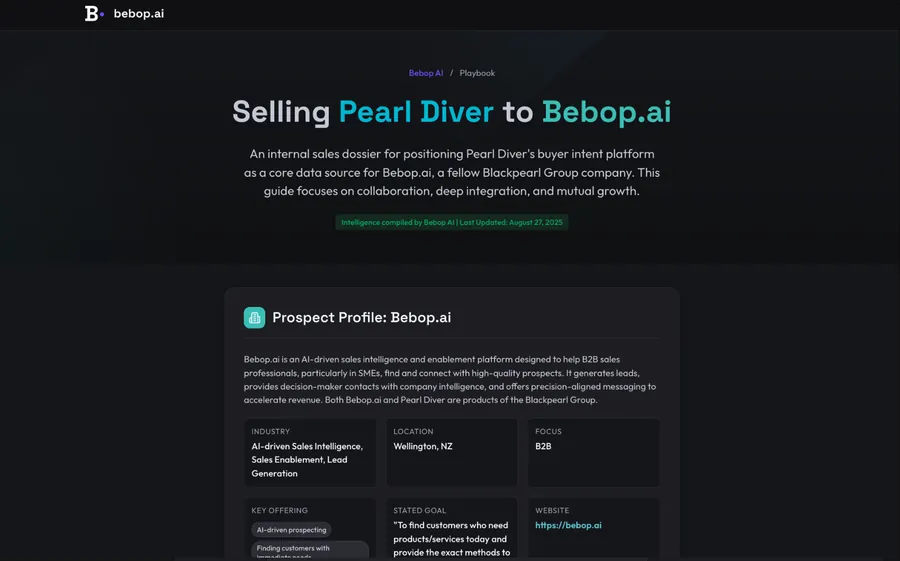
"Selling Pearl Diver to Bebop.ai", an internal Blackpearl Group example. It opens with a dated prospect profile: industry, location, focus, key offering and stated goal.
Check a generated playbook against your team playbook's rules, as you would a rep's work. Before the call itself, the sales call planning template turns the account playbook into a one-page plan.
Rules your playbook should state
A playbook that tells reps to send email and make claims should also say what the rules are. This is general information for US sellers, not legal advice.
- Cold email to businesses is covered. The FTC's CAN-SPAM guide says the law makes no exception for business-to-business email. Use accurate headers and subject lines, include a valid physical postal address, tell people how to opt out, and honor opt-outs within 10 business days. Each violating email can cost up to $53,088.
- Claims need a basis before you make them. The FTC expects advertisers to have a reasonable basis for objective claims before they're made. Put the source next to every number in your proof library, and remove any you can't support.
- Calls have their own rules. The outbound call scripts page summarizes the US and UK rules for business calls.
- Customer names and results need permission. Note in the proof library who approved each story, and when.
Maintenance and coaching checklist
AFTER EVERY WON OR LOST DEAL
[ ] Rep adds the real reason, in one line, to the win/loss log
[ ] New objection or competitor claim? Add it to the inbox for review

MONTHLY (owner, 1 hour)
[ ] Review the inbox and win/loss log; make changes
[ ] Check every proof point still has a source and permission
[ ] Remove anything a rep reported as wrong

QUARTERLY (owner plus two top reps, half a day)
[ ] Re-read sections 1 to 3 against the last quarter's wins
[ ] Retire openers that stopped getting replies
[ ] Update disqualifiers from lost deals
[ ] Bump the version number and log what changed

IN COACHING (weekly, per rep)
[ ] Listen to one call together
[ ] Compare it with the playbook: research, opener, questions, objections
[ ] Agree one thing to keep and one thing to change
[ ] If the rep did better than the playbook, update the playbook
To test whether the playbook works, give a rep five minutes with it and ask: Who don't we sell to? What are our three triggers? What do you check before first contact? What do we need to know before a proposal? What's our answer to the most common objection? Where's the battlecard for our main competitor? Any question they can't answer from the document points to the section to fix.
Common mistakes
- Writing it from a brainstorm. A playbook built on what leaders believe, rather than on deals and recordings, describes the sales motion you wish you had.
- Making it a 40-slide deck. Nobody opens a deck mid-call. Keep it short and link out.
- No disqualifiers. Without them, reps spend their best hours on accounts that can't buy.
- Pasting scripts in full. Pasted scripts drift out of date in two places. Link to one master copy.
- No owner. Shared ownership means nobody updates it, and a stale playbook teaches the wrong things.
- Treating it as a script. It's a set of defaults. A rep who beats it should change it.
Next step: fill in the objections module from real calls with the objection handling guide, then add your main competitors with the sales battlecard template.
Sources
- GTM-Bench: Evaluating Agentic AI Systems for Buyer/Seller Coherence in Go-to-Market Workflows, Blackpearl Group, June 2026
- CAN-SPAM Act: A Compliance Guide for Business, Federal Trade Commission, accessed 25 October 2026
- FTC Policy Statement Regarding Advertising Substantiation, Federal Trade Commission, 23 November 1984
Written by the Bebop team at Blackpearl Group. Last updated .
Questions people ask
What should a sales playbook include?
Who you sell to and who you don't, the roles you talk to, why customers buy in their own words, and four working modules: research, messaging, qualification and objections. Add your deal stages with exit criteria, a competition section that links to battlecards, the email and calling rules you follow, and an owner with a review date. Link to full scripts and templates rather than pasting them in.
What is the difference between a sales playbook and a sales process?
The sales process is the sequence of stages a deal moves through, such as discovery, evaluation, proposal and close, with criteria for moving between them. The playbook is the guide to carrying it out: who to target, what to check, what to say, what to ask and how to respond at each stage. Most playbooks include the process as one section.
How long should a sales playbook be?
Short enough that a rep can find an answer in under a minute. For most teams that's about six pages for the team playbook, with links out to email templates, call scripts and battlecards, and one page for each account playbook. If yours is a 40-slide deck, split the reference material out and keep the core decisions in the playbook itself.
What is an account-specific sales playbook?
A one-page plan for winning one target company. It names the people involved, records the trigger that makes now a good time with its source and date, states the angle you'll open with, lists the objections that account is likely to raise and the gaps in your qualification, and sets the next step. It applies the team playbook to a real account.
How often should you update a sales playbook?
Review it properly once a quarter, with the owner and two of your best reps, and make small fixes monthly from a running log of win/loss reasons and new objections. Change it immediately when something it says is wrong, such as a competitor changing its pricing or an opener that has stopped working. Record each change and bump the version number.